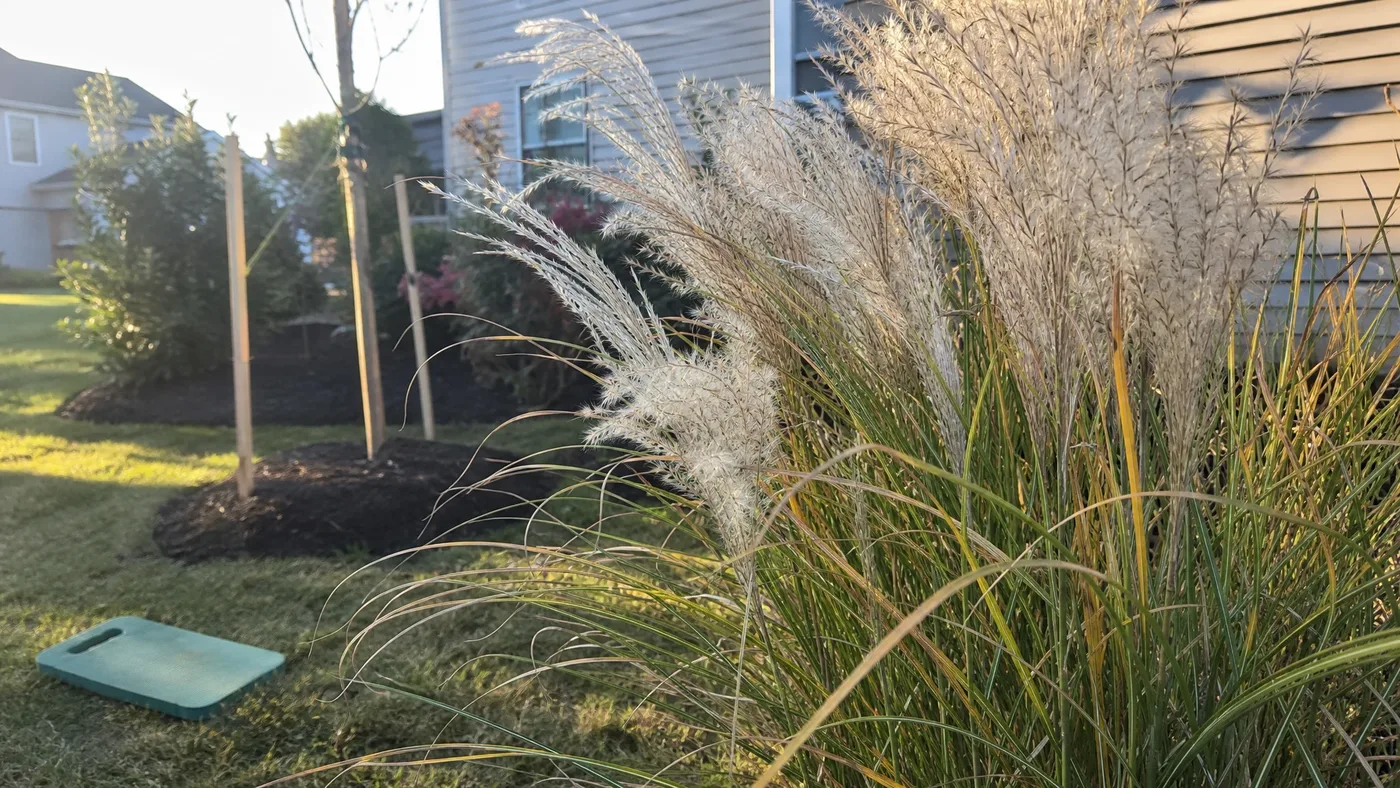
Is Adagio Grass Invasive? Spread, Seedlings and Clump Habit
Adagio grass does not run, and it will not take over your bed. But it is not seed-proof either. It grows as a tight clump that widens slowly, and that part is easy to live with. The part to watch is the seed, because Miscanthus sinensis has naturalized in 25 states and a five-year trial expected Adagio to set viable seed.

That mix matters. Plant it with your eyes open and you get a neat, low-fuss clump with pink-tinged plumes that age to creamy white. Ignore the seed and you may find seedlings where you never planted any, which is a bigger problem in some states than others.
This article talks about how Adagio spreads, whether its seed escapes, what to do about seedlings and how to check your local invasive list, and answers the questions customers ask us most. Read on to learn how to keep this grass exactly where you put it.
Adagio Grass Invasiveness: The Straight Answer
Here is the short version, and the reason we stop short of calling Adagio completely harmless.
The Short Answer
The first part of the answer is about the plant's habit, which is the easy part.
Adagio does not spread by runners. It is a clumping grass, and the clump widens slowly from the center. Plant one and it stays where you put it, year after year. Customers usually ask us whether it will take over a bed, and for the clump itself the answer is no. There is nothing to dig out along an edge and nothing creeping under the path.
Seed is the open question. The species, Miscanthus sinensis, has naturalized in 25 states, the District of Columbia and Ontario, and it sits on invasive plant lists in places such as Illinois, Alabama, Connecticut and Georgia. That record comes from seedlings, not from creeping roots.
Why We Don't Call It Harmless
One piece of advice you will hear is that a named cultivar is automatically tame. We don't repeat it for Adagio.
A five-year trial found that many M. sinensis cultivars produced viable seed. It listed Adagio among the earliest-blooming cultivars where viable seed was expected. The same study showed that seed production and viability varied significantly between cultivars, so each one has to be judged on its own record.
That is the reason we won't say "sterile" or "non-invasive" about Adagio. No source supports either word.
Where That Leaves You
So the honest answer has two halves. As a clump, Adagio is well behaved and slow. As a seed producer, it carries the same question mark as the rest of its species, and your state's rules decide how big that question mark is.
Neither half is a reason to panic. It is a reason to spend a few minutes checking your local list, mulch the clump and cut the old stems on time. The sections below cover each of those steps.
How Adagio Grass Spreads: A Slow, Tight Clump
The clump is the reason Adagio suits small spaces. This section covers how it grows, how wide it gets and what to do as it ages.
Clump Habit With No Runners
Here is how the plant actually fills in, and why you can stop worrying about creeping.
Adagio sends up new stems from the edge of its own crown, so the plant grows outward in a ring rather than marching across the soil. There are no runners to cut, no edging to sink and no shoots to chase through the neighboring perennials. The species is a medium grower, and Adagio's compact size keeps its footprint small.
If you want the full comparison with its larger relatives, we lay it out in our guide to Adagio grass vs maiden grass.
How Wide and Tall It Gets
Adagio's figures run well below the species.
This table sets Adagio next to the species so you can see how much smaller the footprint is.
| Trait | Adagio | Species Miscanthus sinensis |
|---|---|---|
| Height | About 3.3–5 feet | 4–12 feet |
| Spread | About 1.6–3.3 feet | 4–6 feet |
| Habit | Slow, tight clump | Clump that grows at a medium rate |
| Seed | Viable seed expected in the trial | Many cultivars set viable seed |
Adagio has a mature spread of about 1.6 to 3.3 feet, while the species reaches 4 to 12 feet tall. Treat the species numbers as a warning about what a seedling could become. A stray seedling is not a small Adagio. It is a plant with unknown habit that may grow far taller.
Managing the Clump as It Ages
Because Adagio does not run, there is little to control. What you will notice is slow change.
Over the years the clump widens, and the center can thin. When that happens, lift it and split it, and our guide on how to divide and propagate Adagio grass walks through the steps. Give new plants room using our spacing guide and a mature clump will not crowd its neighbors.
Does Adagio Grass Set Seed That Escapes?
Yes, it can set seed. How much escapes depends on your site, and the research is thinner than we would like.
What the Five-Year Trial Found
The best evidence available comes from a long evaluation of ornamental grasses.
The trial reported that viable seed was expected for the earliest-blooming cultivars, naming 'Ferner Osten', 'Adagio' and 'Nippon'. Even late bloomers such as 'Gracillimus', 'Morning Light' and 'Dixieland' produced seed, though in lower quantities. Late bloom did not mean seed-free.
As the trial went on, more and more seedlings carpeted the plots and the landscapes next to them each spring. The researchers could not tell which cultivars were responsible. No Adagio seed count is given, so we won't quote one.
Why Wind Makes Seed a Garden Problem
Seed is only a problem if it travels, and Miscanthus seed does.
Wind-disseminated seeds increase the invasive nature of maidengrass. That is the mechanism behind every escape story. A plant that never runs can still turn up in a neighbor's border, a ditch or a field edge, because the wind carries the seed there for it.
What This Means for Adagio Specifically
Adagio differs from the tall species in a few ways that help you, and one that does not.
Adagio has pink-tinged, tassel-like flower heads in summer that turn creamy white in autumn. Early plumes give seed a long season to ripen, which fits the trial's expectation. The upside is size. At roughly 3.3 to 5 feet, Adagio's plumes sit within easy reach, so you can cut them. A species plant at 10 feet or more is a different job.
If you are wondering about starting plants from seed yourself, we cover that in can you grow Adagio grass from seed.
What to Do About Adagio Seedlings
Seedlings are manageable if you catch them early. This section covers how to spot them, a short checklist for removal and the mistakes to avoid.
Spot Them Early
Look in the right places and at the right time, and the job takes minutes.
A seedling looks like a small tuft of narrow, grass-like leaves in a spot where you planted nothing. Check the bed around each clump, mulch edges, gravel, cracks in paving and any bare soil downwind. Do the walk-through in spring, which is when the trial saw seedlings appear. One of the most common questions we get is whether pulling them is enough. Early on, it is.
Seedling Checklist
Run through these steps once each spring and you will rarely have more than a handful to deal with.
- Pull any young grass tufts you did not plant. Small ones come out by hand when the soil is damp.
- Dig larger seedlings out with a spade and take the whole crown, because a piece left behind will regrow.
- Keep a heavy layer of mulch around the clump. Heavy mulching helps prevent seed germination.
- Cut the old stems and flowered stems down in spring, before new growth starts.
- Check again a few weeks later, since seedlings do not all appear at once.
Plume Timing and Common Mistakes
Many people leave plumes standing all winter for looks. That is a fair choice in a tidy bed, but we don't push it near open ground.
If your yard backs onto a field, ditch or natural area, cut the plumes once they turn creamy white instead of waiting. Our guide on when and how to cut back Adagio grass covers the full annual cut. In a tight city bed with no open ground nearby, spring cutting is fine.
Mistake 1: Pulling only the tops. Snapping off leaves leaves the crown, and the seedling returns. Get the whole plant.
Mistake 2: Dumping clippings at the edge of woods. Plumes can still carry seed, so bag them or compost them hot, away from natural areas.
Checking Your Local Invasive List
Rules differ by state, and they change. This section shows where to look and what to do with what you find.
Where to Look
Start with your state's invasive plant list, then ask your local extension service.
Search for Miscanthus sinensis, not only for Adagio, because lists may name the species rather than each cultivar. The species is listed in Illinois, Alabama, Connecticut and Georgia, but we don't quote the status of every state, since lists get updated. Your extension office can also tell you whether the rules restrict planting, selling or both.
If the Species Is Listed Where You Live
A listing changes the advice. We would rather you choose a different plant than plant Adagio and hope.
Cultivars bred to be less fertile are worth seeking out, including Bandwidth, My Fair Maiden and 'Scout'. We can't speak to how those perform in every region, so check each one against your local list too. Where the species is restricted, a non-Miscanthus grass is the safest swap.
If It Is Not Listed
Then plant Adagio and keep the routine light.
Mulch heavily, cut the old stems in spring, and walk the bed once each spring for stray seedlings. If you ever see seedlings spreading beyond your property line, treat that as a signal to cut plumes earlier. The clump will behave itself. The seed is what you keep an eye on.
Adagio Grass: Slow Clump, Honest Seed
Adagio grass is a slow, tight clump with no runners, about 1.6 to 3.3 feet wide when mature. The clump will not take over a bed. The seed is the real question, because the five-year trial expected viable seed from Adagio and the species is on invasive lists in several states. Check your local list, mulch heavily, cut the old stems in spring and pull any seedlings while they are small.
Adagio Grass
Nursery-grown Adagio Grass in sizes from 1 Gallon, shipped to your door.
From $31.97
Shop Now →Before a plant leaves us, we look over the crown, roots and foliage of each Adagio to make sure you are planting a sound, true-to-name clump. Our growers raise grasses on our own farms, and as a small business we would rather you know exactly how this one behaves before it goes in the ground.